At WSFT, we use the Model for Improvement—a simple yet powerful approach that helps teams to make meaningful, measurable changes. Continuous Quality Improvement (CQI) empowers the people closest to the work to identify problems, test ideas, and track the impact of their improvements.
The Model for Improvement has two components.
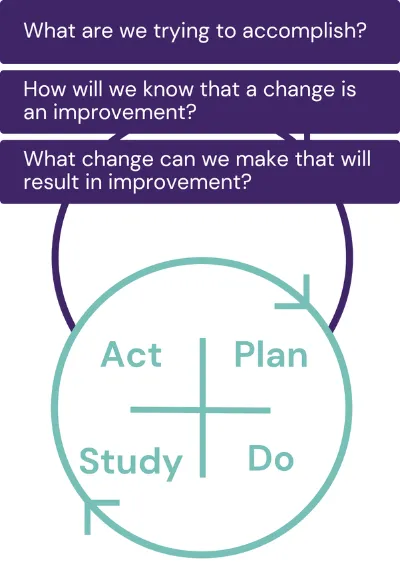
Three Fundamental Questions
What are we trying to accomplish? Define your aim statement clearly and concisely.
How will we know that a change is an improvement? Identify your outcome, process, and balancing measures to track progress and impact.
What changes can we make that will result in improvement? (See Stage 4 of the toolkit). Involve your stakeholders to generate ideas and explore potential change concepts.
The Plan-Do-Study-Act (PDSA) Cycle
PDSA cycles allow you to test change on a small scale, learn from each test, and adapt before wider implementation (See Stage 5 of the toolkit).
Why using QI methodology matters
Using QI methodology ensures you:
- Understand why improvement is needed
- Measure whether improvement is happening
- Develop a change theory that supports your desired outcomes
- Test changes before implementing them, reducing risk and unintended consequences
- Know when and how to scale up a successful change