A replacement hospital for west Suffolk – have your say
We have submitted a Reserved Matters planning application for the new hospital. This is a standard stage in the planning process and follows on from outline approval and our pre-application engagement with staff, patients and the local community. The design will continue to evolve as the scheme progresses through detailed design and ongoing assurance with the New Hospital Programme.
In 2023, outline planning permission was granted for the Hardwick Manor site. This established key principles such as the overall scale of the development, land use and access.
We are now preparing a Reserved Matters planning application, the next stage of the planning process, which focuses on the detailed design of the hospital within those approved principles.
Before submitting the application, we invited feedback which will be reviewed alongside technical assessments, national Hospital 2.0 templates and planning requirements to help inform refinement of the proposals ahead of submission.
What is “Reserved Matters”? Reserved Matters is the second stage of the planning process. Outline planning permission has already been granted. This stage focuses on agreeing how the development looks and works in practice, including building appearance, height, landscaping and parking.
What we asked for feedback on
At this stage, some aspects of the scheme are already fixed through outline planning permission and national Hospital 2.0 templates. Feedback at this early engagement phase will help inform how the detailed design is refined within those approved parameters.
During the engagement, we sought views on…
Building heights and external appearance
Access, transport and movement around the site
Landscaping, ecology and outdoor spaces
Feedback received is being reviewed alongside technical assessments, national Hospital 2.0 templates and planning requirements to inform the Reserved Matters submission.
About the new hospital plans
2019, reinforced autoclaved aerated concrete (RAAC) was identified within parts of the existing hospital structure.
2020 WSFT was accepted on to the national New Hospital Programme
2020 Planning for a replacement hospital began
2023 Outline Planning permission, the first stage of the planning process, was approved for elements of the new hospital, including its overall scale, land use and access. granted for the Hardwick Manor development site
2026 Reserved Matters pre-application engagement completed to invite feedback that will help inform the refinement of the detailed proposals before submission of the reserved matters application, the second stage of planning permission, in the spring.
Bury St. Edmunds has been home to a hospital since 1825, with West Suffolk Hospital moving to its current location at Hardwick Lane in 1973. The hospital has continued to evolve on the site with various new buildings being added since it opened, as well as the renovation of existing buildings including our state-of-the-art Cardiac Centre, Labour Suite, and Acute Assessment Unit.
In 2019, reinforced autoclaved aerated concrete (RAAC) was identified within parts of the existing hospital structure. RAAC is a lightweight form of concrete used widely in the UK between the 1950s and 1990s and is now known to have durability concerns. The West Suffolk NHS Foundation Trust has invested heavily in the upkeep of the buildings over recent years to ensure that the existing hospital is appropriately maintained, and we are able to continue to provide high quality health services for our community. However, whilst the hospital continues to operate safely, RAAC is not a long-term solution for a modern hospital building.
In 2020, West Suffolk NHS Foundation Trust assessed more than 20 potential locations for a new hospital in and around Bury St. Edmunds.
Following detailed evaluation, Hardwick Manor was identified as the preferred site which sits to the south of the current West Suffolk Hospital Hardwick Lane site, adjacent to the current hospital on Hardwick Lane in Bury St. Edmunds.
Outline planning permission was granted for this site in 2023.
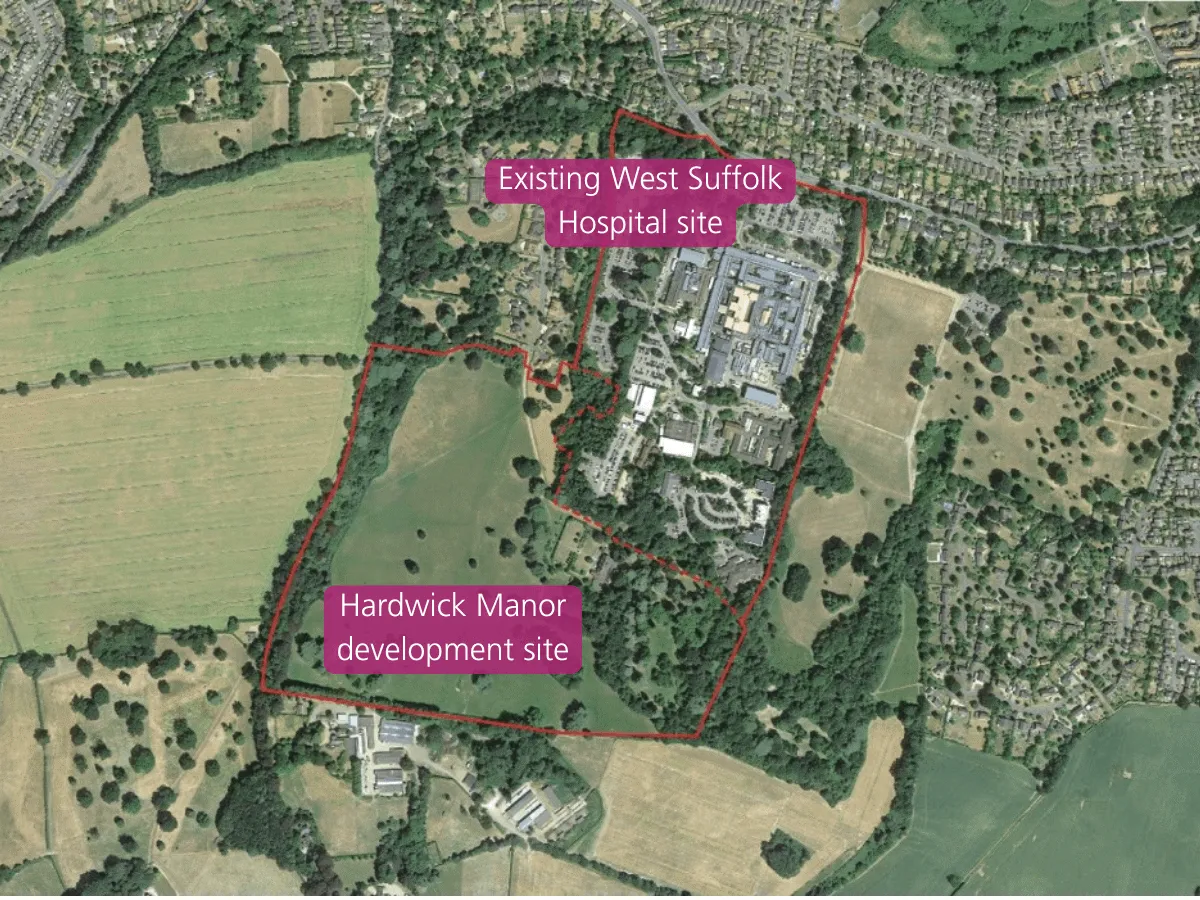
Aerial satellite image of the West Suffolk Hospital site outlined in red, showing the existing hospital buildings, surrounding parkland and tree cover, adjacent residential areas to the north and east, and open farmland to the west and south.
We are part of the government’s New Hospital Programme. One benefit of being part of the national programme is the development of standardised designs known as Hospital 2.0 bringing together best practice, evidence, and real-world learning to define a clear set of requirements that will transform how hospitals are designed, built, and operated.
For our West Suffolk NHS Foundation Trust scheme, this means that Hospital 2.0 will provide design consistency and allow us to take advantage of economies of scale and mitigate supply constraints.
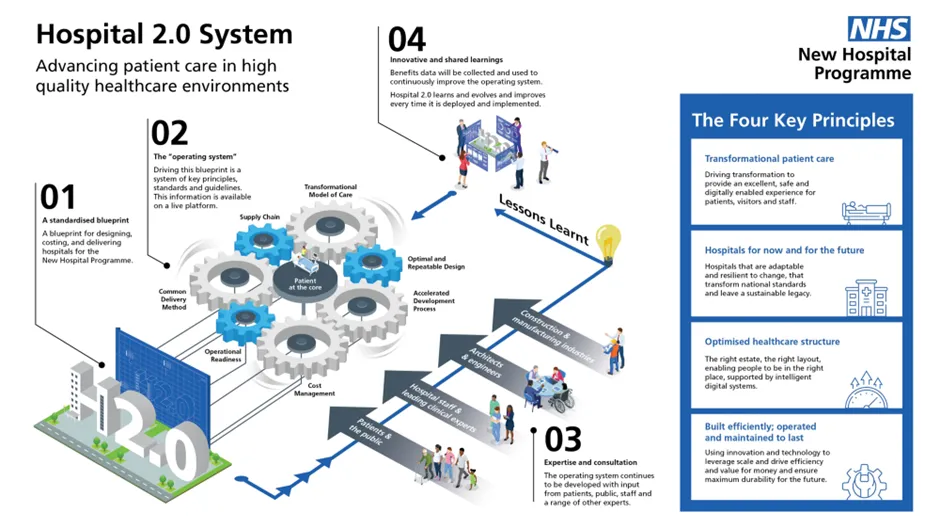
: Infographic titled “Hospital 2.0 System” explaining the NHS New Hospital Programme approach. It shows four components; a standardised blueprint, an operating system, expertise and consultation, and innovative shared learning, which together create the standardised hospital design known as Hospital 2.0. A panel alongside outlines four key principles including transformational patient care and optimised healthcare structure.
Early design principles
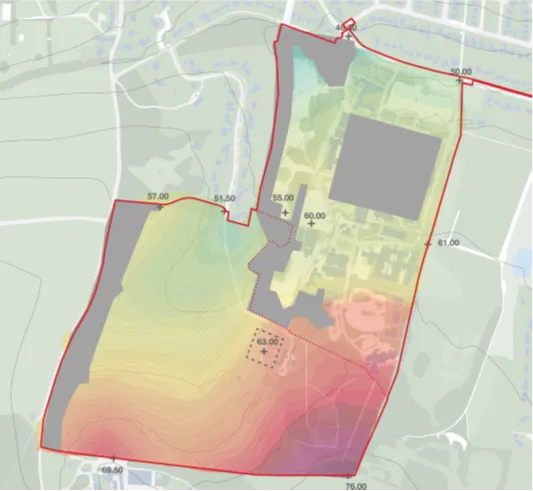
The change in levels across the site creates opportunities to build into the lower areas of the site and use the landscape itself to help reduce the visual mass of the building. The rise in level of the site moving southwards also potentially offers opportunities to access different parts of the building from external ground level but at different internal floor levels.
Topographical plan of the West Suffolk Hospital site outlined in red, showing ground levels using colour shading from lower elevations in red and purple in the south and south-west of the site to higher elevations in green towards the north and north-east. Contour lines and spot height markers indicate changes in level across the site, with the existing hospital buildings shown in grey.
Proposed mitigation planting aims to provide visual screening and filtering effects.
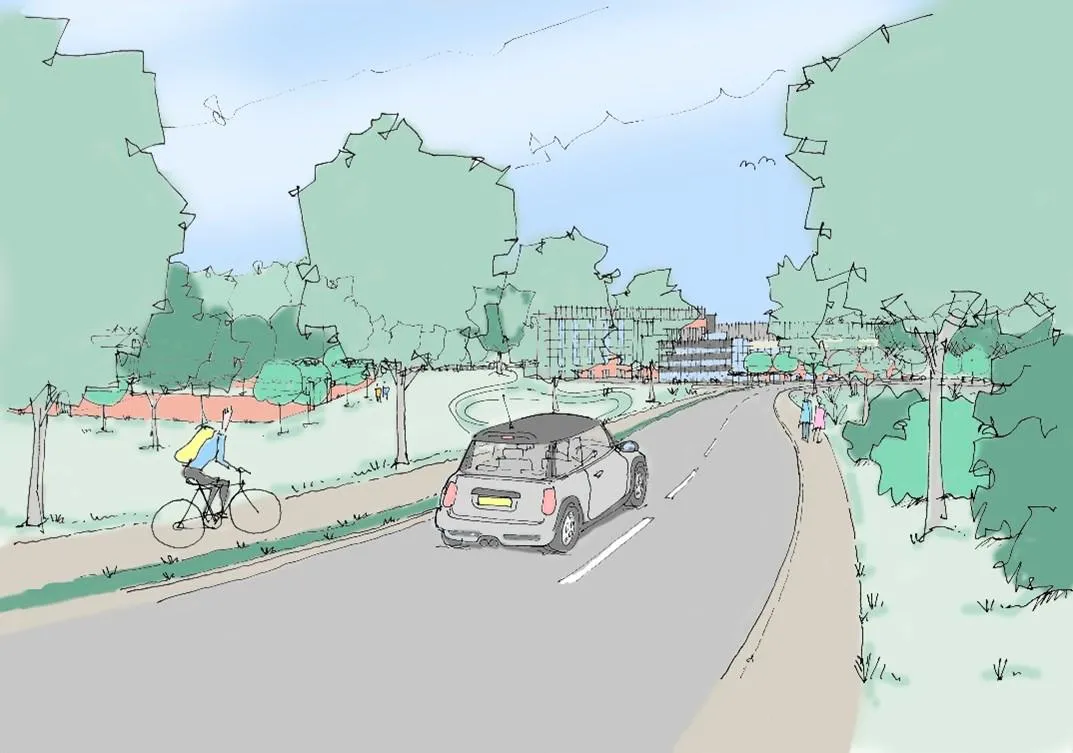
: Illustrative street-level view of a tree-lined access road leading towards a hospital building partially screened by mature trees and planting. A car travels along the road, a cyclist uses a separate path, and pedestrians walk on footways beside landscaped green space.
These principles help shape how the hospital sits in the landscape, which is an area we welcome feedback on.
Early design thinking explores how the new hospital could respond sensitively to the surrounding landscape and local character, with an emphasis on breaking down scale, creating a welcoming environment, and supporting patient and staff wellbeing.
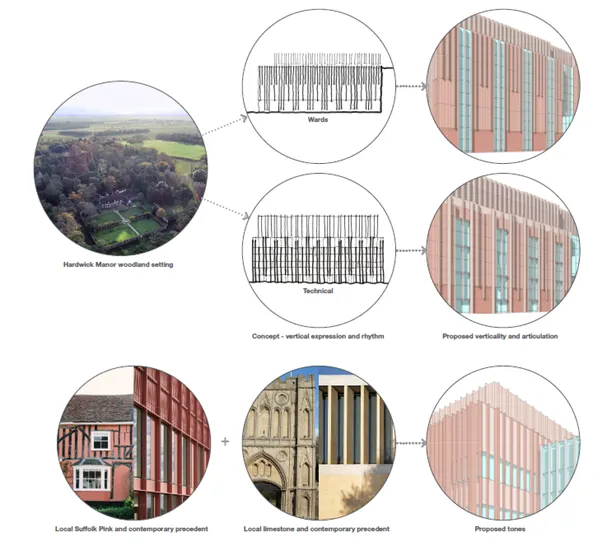
The initial ideas explored around tone and materiality takes its cue from the historic local context of Bury St. Edmund. With the new hospital being a civic institution in the area, use of similar colour tones to reflect the heritage would be appropriate and help embed the new hospital in the context of the local area.
Design concept board showing the architectural inspiration for the proposed hospital. Images include the woodland setting of Hardwick Manor, sketch diagrams illustrating vertical rhythm for ward and technical areas, examples of proposed façade articulation, and local material precedents including Suffolk pink and limestone, leading to a visual of the proposed building tones.
The designs are at an initial stage and will be developed further, based on public input via the reserved matters pre-application engagement as well as Hospital 2.0 façade guidance from the New Hospital Programme team.
Our previous engagement highlighted that transport, access and car parking and are key elements for patients, staff and visitors. Further details can be found in the following drop-down sections.
Public transport routes to West Suffolk Hospital
The new hospital is exploring the inclusion of an on-site bus stop off Hardwick Lane, from where it is proposed that an on-site shuttle bus service will connect to the new hospital.
The Hardwick Manor site has numerous existing mature and high-quality trees with associated walking routes beneath. The aim is to retain these and be a key component of the proposed green arrival sequence through the hospital development.
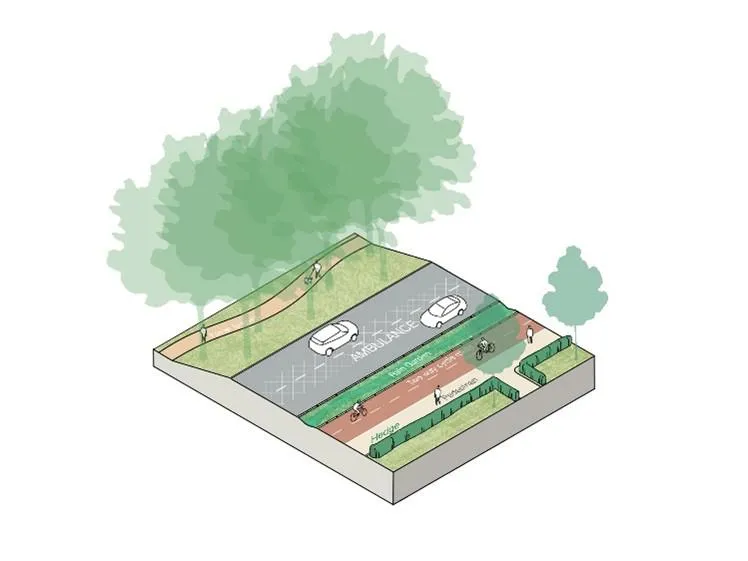
The road carriageway will accommodate all vehicle and the option of resilient access for emergency vehicles, where needed, could be provided via the cycle lane without compromising pedestrian and cyclist safety. The cycle and pedestrian routes will sit directly adjacent to the road.
Illustrative street section showing a two-way road with vehicles travelling in both directions, alongside a segregated cycle lane, pedestrian footways and landscaped planting, with trees providing screening along the site boundary.
New main site entrance and junction to Hardwick Lane
The decision to form a new main site entrance and egress in the location of the existing main site road to Hardwick Lane was taken early in the master planning design process. The current indicative design aims to simplify wayfinding, and detailed design continues to be developed.
Parking
The broad intention of the parking proposals is to use as much of the existing parking on the Hardwick Lane site as practical to help prevent the landscape around the new hospital becoming a sea of tarmac. Not only is this approach more sustainable, but it would also help to save the cost of re-providing car parking areas. New parking provided adjacent to the hospital offers accessible parking for visitors and staff. An electric shuttle bus is proposed to connect the car parking to the new hospital.
Access to retained facilities on the Hardwick Lane site
Access routes to the retained estate facilities such as Wedgwood House, Quince House, Rowan House, Busy Bees nursery and St. Nicholas hospice would be connected into the new site routes, and parking that currently supports these facilities will be retained.
Pedestrian and cycle site access points
The intention is to help connect the new hospital and the retained facilities into a local network of cycle and pedestrian infrastructure by providing cycle and pedestrian access points to the west, east and north. This will connect the site to routes to the centre of Bury St. Edmunds, Hardwick Heath and the conurbations to the east, as well as out towards the villages to the west and south of Bury St. Edmunds.
Landscaping
An overarching principle underlying the landscape design is to create a healthy new hospital environment. A key design intent is to integrate principles of inclusive design with proposals to promote health and wellbeing. These principles inform plans and encourage activity by utilisation of some of the following approaches:
Creating welcoming outdoor spaces that encourage people to spend time outside
Making the most of views across the site and surrounding landscape
Providing safe, accessible walking and cycling routes that connect with existing local networks
Designing routes and spaces that support a range of abilities, from gentle movement to more active use
Including places to pause, rest and enjoy the environment, particularly for those who may need regular breaks
Planting and trees
A strategy of preserving the existing parkland and existing woodland, which is recognised for its significant ecological importance, is a core principle of the masterplan. Overall, the planting strategy aims to enhance and preserve existing habitats, whilst promoting creation of new habitats, through proposed woodland, and diversity of planting across the site.
Detailed planting schedules will be developed at future design stages with ecologist input.
The site is home to 21 veteran trees. Besides these, the site is also home to 39 advanced candidate veterans, with these trees described as ‘not sufficiently old or of a sufficient girth to be described as ‘ancient’, but of a life stage of mature or older and exhibiting at least three ‘veteran features’.
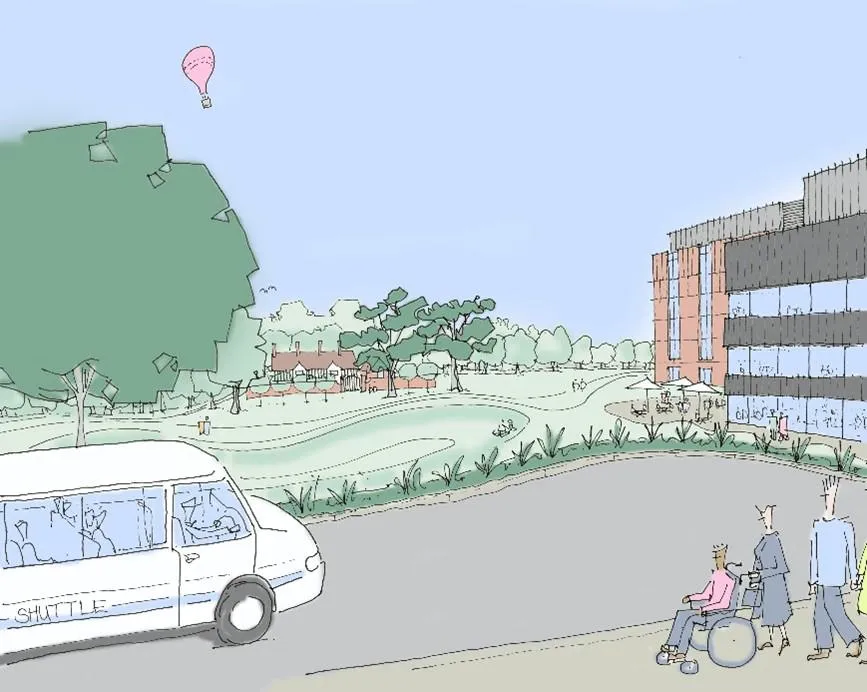
Illustrative view of the hospital entrance area showing a shuttle bus on a two-way road, pedestrians including a wheelchair user on a footway, landscaped green space with trees and planting, the hospital building to the right, and Hardwick Manor visible in the distance beyond the green space.
How your feedback will be used
Feedback received during this engagement period will be reviewed alongside technical assessments, national Hospital 2.0 templates and planning requirements to inform refinement of the Reserved Matters submission.
Following submission, the local planning authority will carry out the formal statutory consultation process, during which members of the public will have the opportunity to comment directly to the Council.
Need more information? If your question isn’t answered on this page, visit our frequently asked questions for more help.